Hamilton Keeps Asking for More: What Are Taxpayers Getting Back?
There was a time when Hamilton’s identity was almost inseparable from industry.
Steel mills lit the harbour. Stelco and other major employers provided thousands of well-paying jobs, and generations of families built their lives around the industrial economy that gave Hamilton its Steel City name.
That Hamilton was not perfect. Recessions, layoffs, pollution and industrial decline were already taking their toll by the 1980s. Stelco’s workforce had once reached approximately 25,000, but changing markets, recession, free trade, globalization and growing international competition gradually reshaped the city’s economic foundation.
Hamilton changed.
The question now is whether the cost of running Hamilton has risen faster than the value residents feel they are receiving.
The Bill Keeps Growing
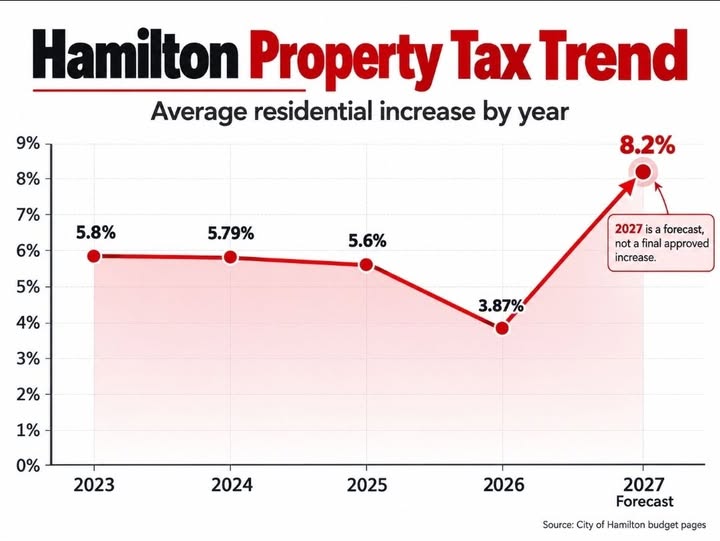
Hamilton homeowners have seen substantial average residential property-tax increases:
2023: 5.8%
2024: 5.79%
2025: 5.6%
2026: 3.87%
Compounded, that is roughly 22.8% over 4 budgets.
Now the City has entered the 2027 budget process with an 8.2% average residential tax-impact forecast, based on a projected $127.9 million increase in the net tax levy.
That does not mean Hamiltonians will receive an 8.2% increase next year. It is a starting forecast, and the final number can change.
But the direction matters.
For residents already dealing with higher food prices, utilities, insurance and housing costs, another increase raises a simple question:
Where is the money going?
There Is a Real Cost to Running a City
It would be easy to blame every increase on waste at City Hall.
It would also be inaccurate.
Hamilton maintains roads, bridges, transit, parks, recreation facilities, emergency services, public health programs, waste collection, long-term care, housing programs and dozens of other services.
Those services cost more when wages, fuel, utilities, construction materials and contracts cost more.
Some pressures also come from outside City Hall.
In 2024, the City attributed 2.55 percentage points of its 5.79% residential increase to provincial legislation that shifted certain infrastructure costs associated with new development toward municipal taxpayers and ratepayers. Another 1.6 percentage points went toward housing and homelessness investments.
In 2025, the average household increase was broken down into approximately $93 for City services, $79 for infrastructure, $77 for police and 911, $25 related to provincial legislation and $11 for boards and agencies.
So there is no single cause behind the tax bill.
But taxpayers are still entitled to examine the receipt.
Spending More Is Not the Same as Getting More
Hamilton’s 2025 budget included approximately $192 million for housing and homelessness programs, along with major spending on infrastructure, emergency services, cybersecurity recovery and other priorities.
Some of that spending may produce benefits residents never directly notice.
A repaired sewer does not receive applause.
A paramedic arriving when someone is having a heart attack matters more than whether someone notices a new flower bed.
And sometimes millions must be spent simply to prevent infrastructure from getting worse.
But when tax bills repeatedly rise, residents should still be able to ask what measurable results followed.
Are emergency services responding faster?
Is infrastructure in better condition?
Is transit improving?
Are neighbourhoods cleaner?
Are homelessness programs producing measurable progress?
Is the City delivering services more efficiently?
And when something is not working, is the spending being reconsidered or simply increased again?
Those are not ideological questions.
They are the questions anyone would ask after receiving a larger bill.
The Hamilton Taxpayer’s Receipt
Imagine City Hall handing every household an itemized receipt:
Here is what you paid.
Here is where it went.
Here is what changed because we spent it.
That final line is the important one.
Governments are very good at announcing investments.
“$20 million invested.”
“$50 million committed.”
“$100 million allocated.”
But money spent is an input.
What happened afterward is the result.
Those 2 things should never be confused.
At the same time, residents need to recognize an uncomfortable reality: paying more does not always mean receiving more.
If asphalt, construction, wages and equipment become more expensive, taxpayers can spend substantially more just to maintain the same services.
That is exactly why another tax increase deserves a clear explanation.
Hamilton Isn’t the City It Was
Perhaps this is where Hamilton’s industrial past belongs in the conversation.
Not because everything was wonderful in 1988.
It wasn’t.
And not because the City can somehow recreate Stelco’s massive workforce through a municipal budget.
It can’t.
But older Hamiltonians remember a city with a very different economic foundation.
Large industrial employers supported thousands of families. Blue-collar wages flowed through neighbourhood businesses, restaurants, stores and homes.
The modern Hamilton economy is different, and so are the responsibilities placed on municipal government.
Nobody should expect Hamilton to operate today on a 1980s budget.
But residents can expect something else:
accountability for what today’s Hamilton costs.
The City says its preliminary 2027 forecast reflects maintaining existing services, inflation, aging infrastructure, housing and homelessness pressures, and public-safety priorities.
Those may all be legitimate needs.
The question is whether residents believe the results justify what they are being asked to pay.
Because after 4 consecutive increases and another potentially significant one being discussed, the debate should not simply be:
“How much more will property taxes go up?”
It should also be:
“What has Hamilton become better at because taxpayers have already paid more?”
Maybe you believe you are receiving good value.
Maybe you believe money is being wasted.
Maybe the answer depends on the service.
So here is the question for Hamilton residents:
When you look around your neighbourhood and at the City services you actually use, where do you believe your tax dollars are being well spent, and where does Hamilton need to do better?
Written by Kristoper Hunter
See less